
AI in MENA Education: When Automation Reinforces Existing Inequality
AI can improve education across the MENA region, but biased historical data and weak institutional oversight may reinforce inequality in admissions, grading, scholarships and student monitoring.

Artificial intelligence has the potential to improve education across the Middle East and North Africa. Educational institutions can use AI to support personalized learning, reduce administrative workload, identify students requiring additional support, improve resource planning, and provide decision-makers with faster access to performance data.
However, AI does not enter an educational system as a neutral force. It enters an existing institutional environment shaped by differences in access, income, geography, gender, language, disability, technology availability, and educational quality.
When these differences are reflected in historical data, an AI system may reproduce them at scale. The risk is not simply that an algorithm might make an occasional mistake. The greater risk is that existing inequality becomes automated, standardized, and presented as an objective result.
Historical data is not automatically fair data
Most AI systems learn from historical information. In education, this information may include previous examination results, attendance records, school rankings, scholarship awards, university admissions, disciplinary records, family income, geographic location, student engagement data, and teacher assessments.
These records describe what happened in the past. They do not necessarily represent what should happen in the future. For example, if students from a particular region historically received fewer educational opportunities, their performance data may reflect underinvestment rather than lower potential.
An algorithm trained to identify ‘high-potential’ students using historical outcomes may therefore favor those who already benefited from stronger educational conditions. The system may not be intentionally discriminatory — but it can still convert unequal opportunity into a mathematical prediction.
Bias can enter at several stages: when data is collected, when features are selected, when the model is trained, when decision thresholds are set, and when outputs are reviewed and appealed. Each stage needs its own control.
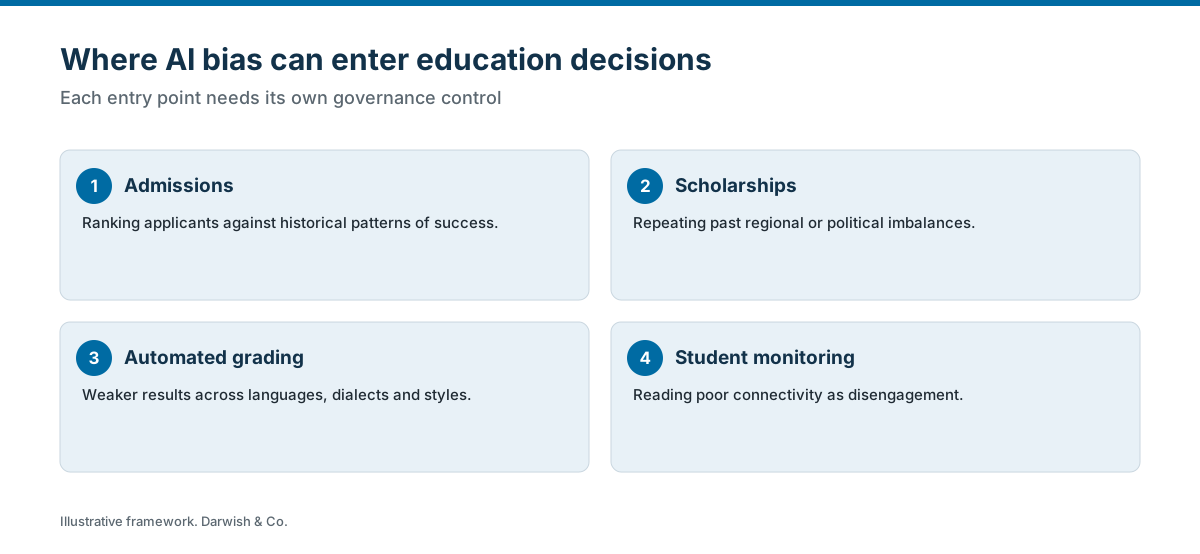
Where AI bias can enter the education system
Admissions and student selection. AI can be used to rank applicants, review documents, assess eligibility, or predict academic performance. These systems may reduce processing time, but they can also disadvantage students whose educational backgrounds do not match historical patterns of successful applicants. Without careful governance, the system may reward privilege while describing the result as academic merit.
Scholarships and financial support. Scholarship systems often need to balance academic performance, financial need, geographic distribution, and institutional priorities. If earlier decisions contained bias, political influence, or unequal regional representation, the AI system may reproduce the same pattern.
Automated grading. Grading systems may perform differently across languages, writing styles, and cultural expressions. A model trained primarily on one linguistic or educational context may misunderstand valid answers produced in another. Automated grading should support educators, not remove professional judgment from the assessment process.
Student monitoring and behavioral analytics. A student who frequently changes devices, has inconsistent internet access, or interacts differently with an online platform may be classified as disengaged or high-risk. The system may interpret economic or technical barriers as behavioral problems.
The regional context matters
AI governance frameworks cannot be imported without considering the realities of each educational environment. Across the MENA region, institutions operate under very different conditions. Some have advanced digital infrastructure and mature data systems. Others continue to rely on fragmented records, paper-based processes, inconsistent data collection, or limited technical resources.
Language adds another layer of complexity. Many global AI systems are developed primarily using English-language data. Arabic includes different dialects, writing styles, educational terminology, and local contexts that may not be represented adequately in the model. A technically successful system in one market may therefore produce weaker or less equitable outcomes when transferred into another. Responsible adoption requires local testing, not assumptions.
Readiness depends on several dimensions at once: digital infrastructure, data quality and coverage, educator AI literacy, governance frameworks, and local language support. A gap in any one of them increases the risk of biased or inequitable outcomes.
Responsible AI principles for educational institutions
Educational institutions should establish clear controls before using AI in decisions that affect students.
- Define the decision boundary. Determine what the system is allowed to do. Can it recommend? Can it rank? Can it reject? High-impact decisions should not be delegated entirely to an automated system.
- Conduct an educational impact assessment. Before deployment, evaluate which students may benefit, which may be disadvantaged, and what the likely effects are on different demographic groups.
- Require local validation. Any AI system used in the MENA educational context should be tested on local data before deployment, not assumed to perform equivalently to results from other markets.
- Maintain educator authority. Teachers and administrators should retain the ability to review, challenge, and override AI recommendations. Professional judgment should not be subordinated to algorithmic output.
- Establish a student appeal process. Students and families should have a clear route to request review of AI-influenced decisions, particularly in admissions, grading, and scholarship allocation.
- Monitor for differential outcomes. Institutions should regularly examine whether AI systems are producing different results for different student groups, and investigate the cause of any significant disparities.
The institutional responsibility
Educational institutions that adopt AI without adequate governance do not simply risk technical failure. They risk embedding and amplifying the inequalities that education is meant to reduce.
The responsibility is institutional, not technical. Vendors can provide products. Data teams can assess performance. But institutional leadership must decide which values the system is required to reflect, which student populations must be protected, and who is accountable when the system produces an unfair result.
AI can be a powerful tool for improving education in the MENA region. But its value depends entirely on the governance environment in which it is deployed.
Is your educational institution exploring AI without a clear adoption and governance framework? Darwish & Co. supports educational institutions in assessing AI readiness, prioritizing practical use cases, strengthening governance, and building role-based capabilities for responsible adoption.
Let’s discuss your next strategic priority.
Tell us what your organization is facing. We’ll help you frame the challenge and identify a practical next step.