
When AI Accelerates the Wrong Decision: Why Human Oversight Is a Governance Requirement
AI can accelerate decisions, but without effective governance it can also scale outdated data, hidden bias and institutional error. The central question is who remains responsible when an AI-supported decision causes harm.

Artificial intelligence is often presented as a way to make organizational decisions faster, more consistent, and more objective. In many cases, it can. AI systems can analyze large volumes of information, identify patterns, prioritize cases, generate recommendations, and reduce the time required to reach a decision.
But speed is not the same as accuracy. Consistency is not the same as fairness. And an algorithmic recommendation is not the same as an accountable institutional decision.
The greater the impact of a decision, the more dangerous it becomes to treat AI-generated output as an automatic instruction rather than one source of evidence within a governed decision process.
What under-governed AI really means
Under-governed AI does not necessarily mean that a system operates without any human involvement. A person may still click the final approval button. A manager may still receive the recommendation. A committee may still officially authorize the decision.
However, human involvement becomes meaningless when decision-makers cannot understand how the recommendation was produced, cannot verify the underlying data, do not know the system's confidence level, lack the authority or time to challenge the result, or automatically approve recommendations because they appear technically credible.
In these situations, the organization may have a human in the process, but it does not have meaningful human oversight. Human oversight should not be a ceremonial approval stage. It should be an active control that can question, delay, reject, escalate, or reverse an AI-supported recommendation.
The risk of automation bias
One of the most important risks in AI-supported decision-making is automation bias — the tendency to place excessive trust in recommendations generated by automated systems, particularly when the output appears precise, confident, or mathematically sophisticated.
The algorithm does not remove weaknesses in the underlying data. It packages them in a form that may be harder to question. This creates a dangerous form of false objectivity: an error begins to appear neutral simply because it has been produced by a system.
When old data produces new harm
AI systems are highly dependent on the quality and relevance of the information they process. An advanced model operating on unreliable data can produce a highly sophisticated version of the wrong answer.
Consider a system that classifies a location, organization, supplier, employee, or student using data collected several years earlier. The model may perform exactly as designed. The failure is not necessarily technical — it may be institutional: nobody confirmed whether the data was still valid, warnings were ignored to meet a deadline, the decision process rewarded speed over verification.
AI can accelerate these failures because it compresses the time between information, recommendation, and action. Without a governance checkpoint, an outdated assumption can become an operational decision within seconds.
Human oversight must include the power to disagree
Organizations frequently state that their AI systems are subject to human review. That statement is not enough. Effective oversight requires more than the presence of a reviewer.
- Access to relevant evidence. Decision-makers should be able to examine the most important data sources, assumptions, exceptions, and limitations behind the recommendation.
- Sufficient time. A review process that gives a manager only a few seconds to approve hundreds of recommendations is not meaningful oversight. It is automated execution with a human signature.
- The authority to reject the recommendation. Employees should not be penalized for challenging the system when evidence indicates that the recommendation may be wrong.
- Clear escalation routes. High-risk or uncertain cases should automatically move to a higher level of review rather than being processed as routine decisions.
- Accountability. The organization must define who owns the final decision. Responsibility cannot be transferred to the software, the vendor, the data team, or an unspecified algorithm.
A practical AI decision governance model
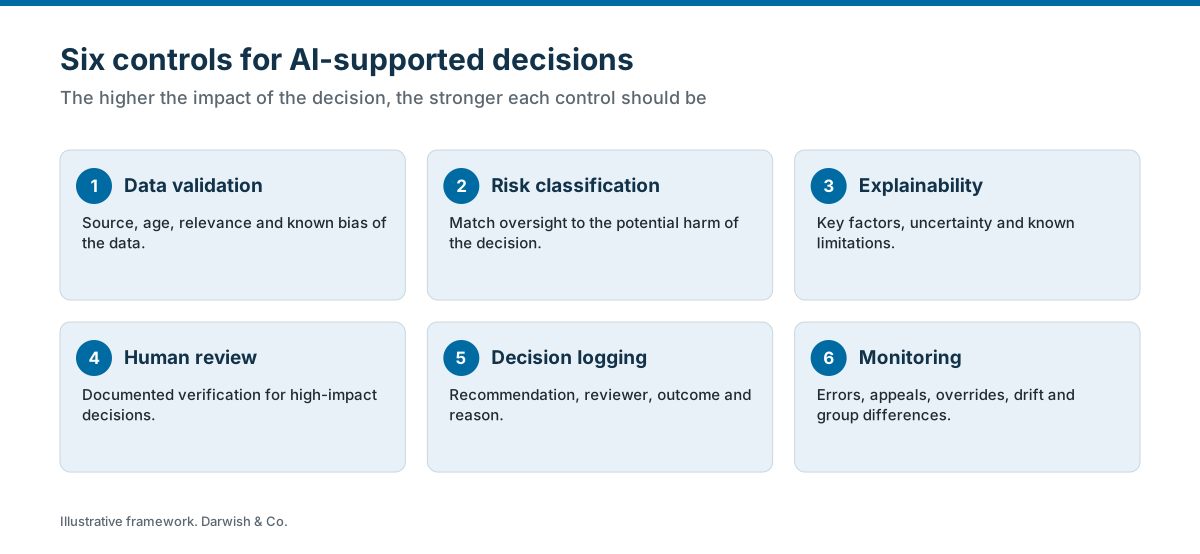
Organizations can reduce the risks of AI-supported decisions by introducing six governance controls. Not every use case needs the same strength of control: the higher the potential harm, the stronger each control should be.
- Data validation. Confirm where the data came from, when it was collected, whether it remains relevant, which populations may be underrepresented, and whether the data contains known historical bias.
- Risk classification. Not every AI use case requires the same controls. The higher the potential harm, the stronger the oversight requirements should be.
- Explainability and decision context. Decision-makers should understand the factors that influenced the recommendation, the system's level of uncertainty, and known limitations.
- Meaningful human review. High-impact decisions should require documented human verification confirming the recommendation is consistent with current evidence and organizational policy.
- Decision logging. Maintain an audit trail showing what the system recommended, who reviewed the case, whether the recommendation was accepted or rejected, and why.
- Continuous monitoring. Regularly examine error rates, complaints and appeals, differences in outcomes between groups, override patterns, data drift, and unexpected consequences.
The executive responsibility
AI governance is not only a technical responsibility. It is an executive and institutional responsibility. Technology teams can build and maintain systems. Data specialists can assess performance. Vendors can explain product capabilities. But leadership must decide which decisions should be automated, which decisions must remain human-led, what level of risk is acceptable, who can stop the process, and who remains accountable when the decision fails.
Organizations should use AI to improve judgment, not to avoid judgment. The ultimate governance principle is simple: AI may inform the decision, but the institution must remain accountable for the outcome.
Conclusion
Artificial intelligence can help organizations analyze more information and respond more quickly. But without effective human oversight, it can also scale inaccurate data, hidden bias, and poor institutional judgment.
Responsible AI is therefore not achieved by adding a final approval button. It requires a governed decision system in which humans can understand, challenge, document, and take responsibility for AI-supported recommendations. The strongest organizations will not be those that automate the greatest number of decisions — they will be those that know which decisions should never be automated without meaningful human judgment.
Is your organization using AI without a defined decision-governance framework? Darwish & Co. supports organizations in assessing AI readiness, prioritizing responsible use cases, and establishing practical governance principles linked to operational value.
Let’s discuss your next strategic priority.
Tell us what your organization is facing. We’ll help you frame the challenge and identify a practical next step.