
AI Does Not Eliminate Institutional Bias — It Can Scale It
AI learns from institutional data. If that data reflects unfair practices, weak governance, or corruption, AI may automate those problems rather than fix them.

Organizations frequently invest in artificial intelligence with the expectation that technology will make decisions more objective. The assumption is understandable. Unlike people, an algorithm does not have personal relationships, political loyalties, emotional reactions, or financial interests.
But this does not mean that the decisions produced by the system are neutral. AI learns from institutional data. It operates within institutional rules. It reflects institutional priorities. And it is deployed through institutional processes.
If those processes are unfair, inconsistent, politically influenced, poorly documented, or vulnerable to corruption, AI will not automatically correct them. It may make them faster, less visible, and more difficult to challenge.
AI learns from what the institution has done
Machine-learning systems identify patterns in historical data. In a well-governed institution, historical data may provide a useful basis for forecasting demand, allocating resources, identifying risk, or improving operations.
But historical records may also reflect preferential treatment, unequal access, inconsistent enforcement, informal influence, unexplained exceptions, political pressure, weak documentation, manipulated performance indicators, and procurement decisions shaped by relationships rather than value.
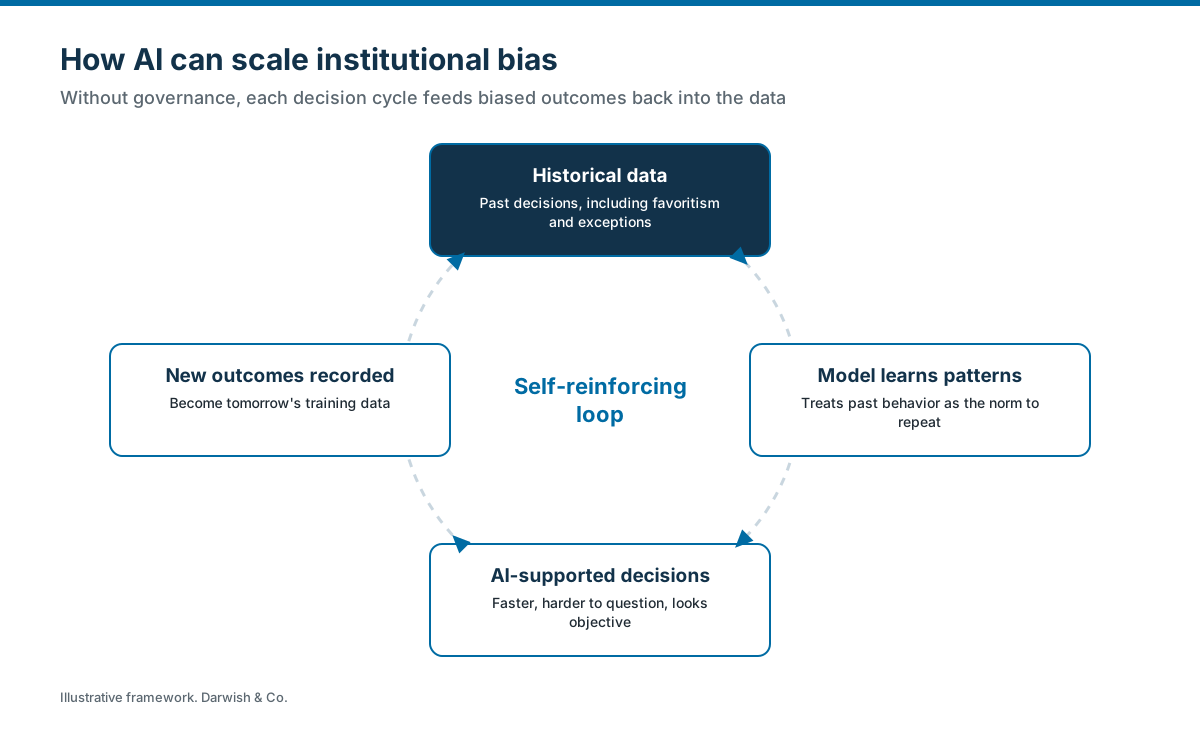
When AI learns from these records, it may interpret abnormal institutional behavior as the normal pattern that should be repeated. Imagine an organization using historical procurement data to recommend preferred suppliers. If previous supplier selections were influenced by personal relationships or incomplete competition, the model may continue recommending the same suppliers. The recommendation may appear data-driven. In reality, the system has learned the history of institutional favoritism.
Without governance intervention, this effect compounds: each decision cycle feeds new outcomes back into the data, creating a self-reinforcing loop that becomes harder to detect and correct over time.
How bias becomes automated
Institutional bias does not always appear as an explicit instruction. An organization rarely tells a system to favor connected individuals or well-resourced institutions. Bias often enters indirectly through variables that appear operationally reasonable.
A resource-allocation model may use historical spending, previous performance, existing infrastructure, past funding absorption, and previous compliance records. Each variable may appear legitimate. But institutions that historically received more resources are more likely to have stronger infrastructure, higher capacity, and better performance records. A model optimizing for past performance may therefore direct additional resources toward already advantaged institutions, while underfunded organizations continue to receive less support because their historical data shows weaker results. The algorithm turns a historical imbalance into a self-reinforcing cycle.
The black box as an accountability shield
One of the most serious risks of institutional AI is not only that the system may produce an unfair decision. It is that the system can make responsibility less visible. When decision-makers are challenged, they may claim: “The system generated the ranking. The software identified the risk. The model selected the supplier. The algorithm recommended the allocation.”
This language creates the impression that the decision was technical and unavoidable. But every AI system reflects human decisions: which problem the system was asked to solve, which data was included or excluded, which outcome was optimized, and who approved deployment. The algorithm does not remove institutional responsibility. It can only make that responsibility easier to hide when governance is weak.
AI procurement is a governance issue
Organizations often focus on what an AI product can do. They pay less attention to how the product was selected, evaluated, contracted, and monitored. An AI procurement process that evaluates only features and price is incomplete. The organization is not simply purchasing software. It is introducing a new decision-making actor into its operating model. Before buying, ask:
- What data was used to develop the system?
- Has the system been tested in our market and language?
- Can the organization independently audit the outputs?
- Who owns the data and the generated insights?
- Can decisions be explained to regulators, employees, citizens, or customers?
Fix the problem before you automate it
Digital transformation initiatives often begin with a desire to automate existing processes. But automating a weak process does not make it strong. It makes the weakness faster.
Before deploying AI, organizations should examine whether the underlying process is clearly documented, consistently applied, legally and ethically defensible, supported by reliable data, protected from conflicts of interest, subject to review and appeal, and owned by an accountable role. Where these conditions are missing, process redesign should come before automation.
Six controls for institutional AI governance
- Process integrity review. Before selecting a technology, review the process the system will support. Identify exceptions, informal practices, approval gaps, conflicts of interest, and areas of inconsistent application.
- Data provenance. Know where each important data source originated, who entered or approved the information, whether the data can be verified, and whether it contains unexplained gaps or manipulation.
- Segregation of duties. No single individual or department should control the data, model configuration, approval process, and final decision. Roles should be separated to reduce manipulation and strengthen review.
- Independent audit. High-impact systems should be reviewed by parties independent from the system owner and vendor. Audits should examine data quality, bias, security, governance, performance, and decision outcomes.
- Decision and override logs. Every significant AI-supported decision should leave a trace: the recommendation, the reviewer, the final decision, the justification, and any override.
- Accessible appeals and reporting. Affected employees, suppliers, students, citizens, or customers should have a route to request review or report suspected unfairness.
AI governance is part of institutional governance
AI governance should not operate as an isolated technical policy. It should connect with corporate governance, risk management, procurement, compliance, data protection, internal audit, human resources, performance management, ethics and integrity, and crisis and reputation management.
This is especially important in public institutions, development programs, education systems, healthcare organizations, and regulated industries. The stronger the impact on people and public resources, the stronger the governance framework must be.
AI can be a powerful instrument for institutional improvement. But it will only deliver that value in organizations that are willing to govern it with the same rigor they apply to their most consequential institutional decisions.
Before automating an institutional process, verify that the process is ready to be automated. Darwish & Co. supports organizations in reviewing AI readiness, process maturity, governance controls, use-case risk, and implementation priorities.
Let’s discuss your next strategic priority.
Tell us what your organization is facing. We’ll help you frame the challenge and identify a practical next step.