
Consumer Research in MENA: A Practical Guide for Market Entry
Entering a MENA market on assumptions is expensive. A focused consumer research programme, designed around the entry decision and the region's cultural realities, reduces that risk.
Companies entering a new market in the Middle East and North Africa often rely on three sources of confidence: success in their home market, a distributor's enthusiasm, and a few visits to the capital city. Each is useful. None is a substitute for understanding the consumers who will decide whether the product succeeds.
The region is not one market. Purchasing power, retail structure, dialect, media habits and social norms vary sharply between countries, and often between cities in the same country. What sells in one Gulf capital may need a different price point, pack size or message in Cairo, Casablanca or Amman.
Consumer research does not remove risk, but it turns hidden assumptions into tested ones before you commit capital, sign exclusive agreements or design a launch campaign.
Why entering without research is costly
The cost of skipping research rarely appears as a line item. It shows up later, as:
- a price set for the wrong segment, followed by expensive discounting;
- packaging, claims or imagery that do not fit local expectations;
- a channel strategy built for modern retail when much of the category still moves through traditional trade or online marketplaces;
- a distributor chosen for availability rather than fit with the target customer;
- marketing budgets spent on messages that do not resonate.
Each of these is harder to reverse once the brand is in market. A modest research investment before entry is usually far cheaper than correcting a launch afterwards.
Methods that work in the region
No single method answers every question. A good programme combines several, chosen for what the decision needs.
Desk research. Start with what already exists: official statistics, trade data, company filings, industry reports and media coverage. Desk research frames the market, identifies gaps and prevents you from paying for fieldwork to answer questions that are already answered. Check the date and method behind any figure you use.
In-depth interviews. One-to-one conversations with consumers, retailers, distributors or experts. They are especially useful in the region for sensitive topics, for senior or hard-to-reach respondents, and where people may speak more openly in private than in a group.
Focus groups. Group discussions reveal shared language, perceptions and reactions to concepts. In MENA they need cultural care: groups are often separated by gender, and sometimes by age or social background, so that participants speak freely. A moderator who shares the participants' dialect and understands local norms matters as much as the discussion guide.
Online and telephone surveys. Quantitative surveys measure how widespread attitudes and behaviours are, and allow comparison across segments. Online panels are efficient for connected urban populations, but may under-represent older, rural or lower-income consumers. Telephone or face-to-face interviewing can fill those gaps. Know who your sample reaches and who it misses.
Retail and store audits. Systematic visits to outlets to record which products are on shelf, at what prices, in what pack sizes, and with what visibility. In markets where traditional trade is important, audits of small grocers and kiosks often reveal more about the real competitive set than any report.
Mystery shopping. Trained shoppers experience the purchase or service journey as a customer would. This is useful for testing competitor service, distributor performance, and how products are actually recommended at the point of sale.
Social listening. Analysis of public conversations on social media and review platforms. It is fast and relatively low cost, but it reflects the vocal online minority, and Arabic-language analysis requires tools and analysts that can handle dialect and code-switching between Arabic, English and French.
Language, sampling and translation
Dialect matters. Modern Standard Arabic is understood widely, but everyday consumer conversations happen in local dialects. Questionnaires, discussion guides and stimulus material should be written so they feel natural to respondents in each market, not just grammatically correct.
Translate carefully, then check. A structured process reduces the risk that a translated question means something different from the original. A common approach, reflected in World Health Organization guidance for translating survey instruments, is forward translation by native speakers, independent back-translation, and review by a panel that resolves differences. Add a small pilot with real respondents before full fieldwork.
Sample for the decision. Define the target consumer precisely, then design the sample to reach them: by city, age, gender, income and channel use. Where national samples are expensive, it is often better to cover two or three priority cities well than an entire country thinly.
Fieldwork norms and respondent consent
Gender and cultural norms. Matching interviewer and respondent gender is often expected, particularly for in-home interviews and some product categories. Timing matters too: fieldwork schedules should allow for working weeks, prayer times, Ramadan and public holidays, all of which affect availability and behaviour.
Respect and trust. Explain clearly who is conducting the research and why, and avoid anything that looks like a sales pitch. The ICC/ESOMAR International Code, the main international standard for the research profession, rests on principles of honesty and transparency, due care for participants, protection of personal data, and accountability of the researcher.
Consent and data protection. Tell participants how their data will be used and obtain their consent before collecting personal information, recordings or images. Several MENA countries now have personal data protection laws, so confirm the current rules in each market before fieldwork, and make sure your research agency stores and transfers data accordingly.
Scoping research to the market-entry decision
The most common mistake is commissioning a broad "market study" without a clear decision in mind. Start instead with the decision and work backwards:
- State the decision. For example: should we enter this market in the next eighteen months, and if so, with which product range, at what price, and through which channels?
- List the critical assumptions. Which beliefs, if wrong, would change the decision? Typical examples are the size of the target segment, willingness to pay, channel preference and brand perceptions.
- Match each assumption to a method. Desk research for market structure, interviews and groups for perceptions and language, surveys for size and price sensitivity, audits for the competitive shelf.
- Set decision rules in advance. Agree what results would lead you to proceed, adjust or stop. This keeps the research honest and the conclusions usable.
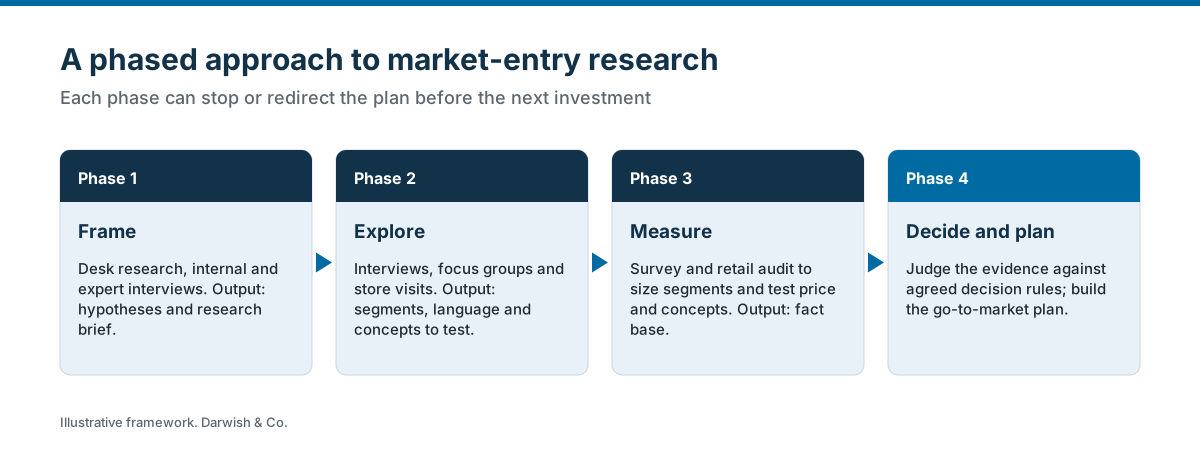
A phased plan
Phase 1: Frame (two to four weeks). Desk research, stakeholder interviews inside your company, and a small number of expert interviews in the target market. Output: a clear hypothesis list and research brief.
Phase 2: Explore (four to six weeks). In-depth interviews, focus groups and store visits to understand how consumers think, speak and buy. Output: segments, language and concepts to test.
Phase 3: Measure (four to eight weeks). A quantitative survey and retail audit to size segments, test price and concepts, and map the competitive set. Output: a fact base for the business case.
Phase 4: Decide and plan. Bring the evidence together against the decision rules agreed at the start. Translate findings into the go-to-market plan: target segment, proposition, price, channel and launch priorities.
Timings vary with the number of markets and the complexity of the category, but phasing allows you to stop or redirect early if the first findings change the picture.
Research as a discipline, not a formality
Good consumer research is not a report that sits on a shelf. It is a disciplined way of testing what you believe before the market tests it for you. In a region as diverse as MENA, that discipline is often the difference between a launch that has to be rescued and one that builds steadily.
If you are evaluating entry into Egypt or another MENA market, Darwish & Co. can help you frame the decision, design a proportionate research programme, manage fieldwork partners, and turn the findings into a practical market-entry plan.
Let’s discuss your next strategic priority.
Tell us what your organization is facing. We’ll help you frame the challenge and identify a practical next step.