
Finding the Handoffs That Slow Decisions Down
Most delays in approvals and decisions come not from the work itself but from waiting between steps. Mapping the flow end to end shows where momentum is lost and what to change.

Ask a manager why a decision took three weeks and the answer is usually about effort: the analysis was complex, the team was busy, the information was hard to collect. Sometimes that is true. More often, if the flow is traced step by step, the actual work took a few hours. The rest of the time was spent waiting.
Work waits in inboxes, in approval queues, in meetings that have not yet been scheduled, and on desks of people who are not sure the next step is theirs. Each time a piece of work moves from one person or team to another, there is a chance it will stop. These handoffs are where most momentum is lost, and they are rarely visible in any report.
Where the time actually goes
When an approval or decision flow is examined closely, the time tends to fall into a few categories:
- Waiting between steps. The file is complete but sits until the next person picks it up, often because they do not know it has arrived or do not see it as urgent.
- Rework. The request goes back because information was missing, a form was outdated, or the reviewer expected a different format.
- Unclear approvals. Nobody is sure who must sign, so the request is sent to several people "to be safe," or it waits for the most senior person available.
- Duplicated checks. Two or three functions review the same thing, each for slightly different reasons, often in sequence rather than in parallel.
None of these adds value to the decision itself. They add time, and they add frustration for the people waiting on the outcome, whether a customer, a supplier or an internal team.
Mapping the flow end to end
The most reliable way to see this is to map one decision or approval flow from start to finish. Lean practitioners call a version of this value-stream mapping, which the Lean Enterprise Institute describes as diagramming every step in the material and information flows needed to deliver a product or service. The same thinking applies well to office and management processes, where the "material" is usually a request, a file or a decision.
A practical approach:
- Choose one flow. Pick a decision that recurs and matters, such as approving a capital purchase, onboarding a new supplier, granting a credit limit, or issuing a non-standard quotation.
- Walk the process. Follow a few real recent cases from the moment the request was raised to the moment the decision was communicated. Speak to each person who touched them. Do not rely only on the written procedure; record what actually happened.
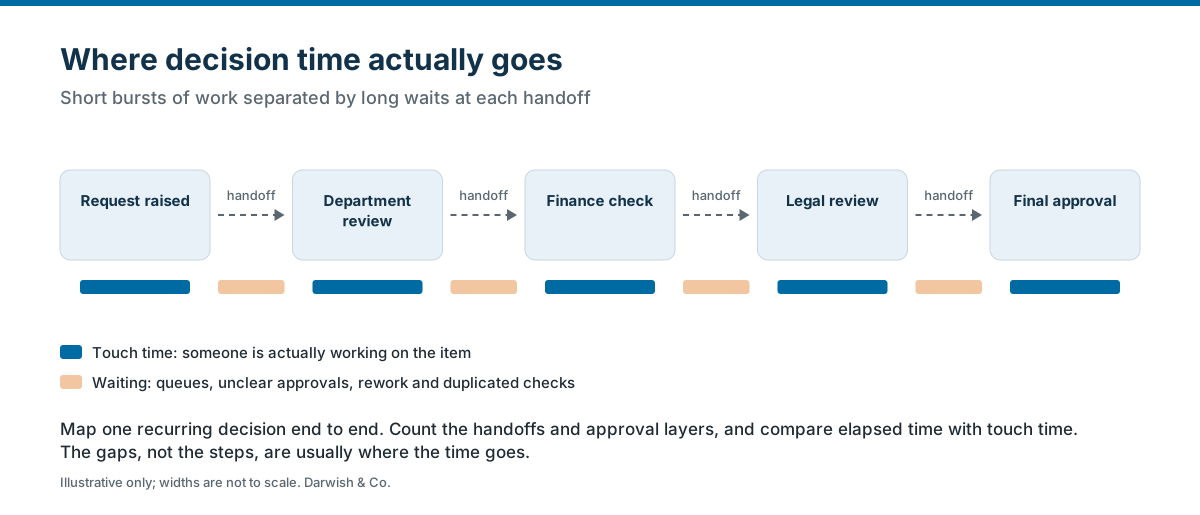
- Separate touch time from elapsed time. For each step, estimate how long someone actually spent working on the item, and how long the item spent at that step in total. The difference between the two is waiting.
- Count the handoffs. Note each time the item moved between people or teams. Each handoff is a point where work can stop.
- Count the approval layers. Note how many signatures or sign-offs were required, and whether each one changed the outcome or simply confirmed it.
An illustrative example makes the pattern clear. Consider a company where approving a new supplier takes, say, around twenty working days from request to decision. When the flow is mapped, the combined touch time across procurement, finance, legal and the requesting department might come to a day or two. The item might pass through seven or eight hands and collect four signatures. These figures are hypothetical, but the shape is common: a small amount of work spread across a long stretch of calendar time.
Common causes
Once the map is drawn, the causes are usually familiar:
- No single owner of the whole flow. Each team owns its own step, but nobody is responsible for the total time from request to decision. Delays between steps belong to no one.
- Approval levels set by habit. Thresholds were set years ago, or never set at all, so routine low-value items go through the same chain as major ones.
- Sequential reviews by default. Reviews that could run at the same time are arranged one after another simply because that is how the process grew.
- Inconsistent inputs. Requests arrive in different formats with different information, so each reviewer spends time asking for what is missing.
- No agreed response times. Teams have no shared expectation of how quickly they should act on an item that reaches them.
- Lack of trust in earlier checks. A later reviewer repeats an earlier check because they are not confident it was done properly.
Practical fixes
The fixes are rarely complicated. What they need is a clear decision to apply them and someone accountable for making them stick.
A single owner per stage, and one for the whole flow. Each step should have one named role responsible for moving the item forward. In addition, one person should own the end-to-end flow and its total elapsed time.
Approval thresholds. Define which decisions can be made at which level, based on value and risk. Routine, low-risk items should be approved close to where the work is done. Senior approval should be reserved for decisions where it genuinely adds judgment.
Parallel reviews. Where finance, legal and compliance each need to review the same request, arrange for them to review it at the same time from a single shared file, rather than passing it from one to the next.
Standard inputs. Agree a short, complete request template or checklist for each flow. If the request arrives complete, most rework disappears.
Service levels between teams. Agree how quickly each team will act on items that reach it, for example a target number of working days for a standard review. These internal service levels should be realistic, visible and reviewed regularly.
Remove checks that do not change outcomes. If a step has not altered a decision in a long time, ask whether it is still needed, or whether a lighter check or a periodic sample review would provide enough assurance. Control functions should be part of this conversation, so that speed does not come at the expense of necessary oversight.
Sustaining the improvement
Handoff problems tend to return if nobody is watching. A few habits help keep the gains:
- Measure elapsed time routinely. Track how long the flow takes from request to decision, not only how long each team takes with its own step.
- Review exceptions. When an item takes much longer than normal, look at why. Exceptions often reveal a gap in ownership or inputs.
- Keep thresholds current. Revisit approval limits periodically, especially after changes in business size, pricing or risk appetite.
- Give the flow owner real authority. The person accountable for the end-to-end flow needs the standing to raise delays with other functions and have them addressed.
- Repeat the map. Re-walk the process after changes are made, and again after some months, to confirm that the improvement has held.
Speed comes from ownership
Slow decisions are usually treated as a capacity problem: too much work and too few people. Sometimes that is the cause. But in many organizations the work is not the bottleneck. The gaps between the work are. Making those gaps visible, and giving each one an owner, is often the fastest way to make the whole organization more responsive.
If important decisions in your organization take longer than the work behind them, the handoffs are a good place to start. Darwish & Co. supports organizations in mapping decision and approval flows, setting approval thresholds and internal service levels, and building the ownership that keeps improvements in place.
Let’s discuss your next strategic priority.
Tell us what your organization is facing. We’ll help you frame the challenge and identify a practical next step.