
What a Decision-Ready Market Brief Contains
Many market studies describe a market well but leave leadership no closer to a decision. A decision-ready brief starts from the question, shows its assumptions, and ends with options and a recommendation.

Most leadership teams have received a market study that was thorough, well presented and of limited use. It described the size of the market, listed the main competitors, summarized trends and included many charts. At the end of the meeting, someone asked, "So should we do it?" and the document did not say.
This is a common pattern. The study informed, but it did not help anyone decide. The problem is rarely the quality of the research. It is that the research was organized around the market rather than around the decision.
Why many market studies inform but do not decide
Market studies often begin with a broad brief: "Tell us about the market for X in Egypt" or "Assess the opportunity in the Gulf." A broad brief produces a broad answer. The researcher collects everything that might be relevant, and the reader is left to work out which parts matter.
Several things tend to go wrong:
- No clear question. Without a defined decision, there is no way to judge which evidence is important and which is background.
- Hidden assumptions. Market size figures are presented as facts, with the assumptions behind them buried in an appendix or not shown at all.
- Description without implication. Competitors are listed, but the brief does not say what their presence means for the company's options.
- No view on confidence. Strong evidence and educated guesses are presented in the same way, so readers cannot tell which conclusions are firm.
- No recommendation. The study stops at analysis and leaves the judgment entirely to the reader.
Start from the decision
A decision-ready brief begins by writing down the decision leadership actually faces, in one sentence. For example: "Should we launch our product range in a second governorate within the next year, and if so, through which channel?" Or: "Should we acquire a distributor or build our own sales team in this market?"
From that decision follow a small number of questions the research must answer. Is the demand there? Can we reach customers at an acceptable cost? Can we compete on price and service? What would stop us? Each section of the brief should exist because it helps answer one of those questions. Anything that does not can be moved to an appendix or left out.
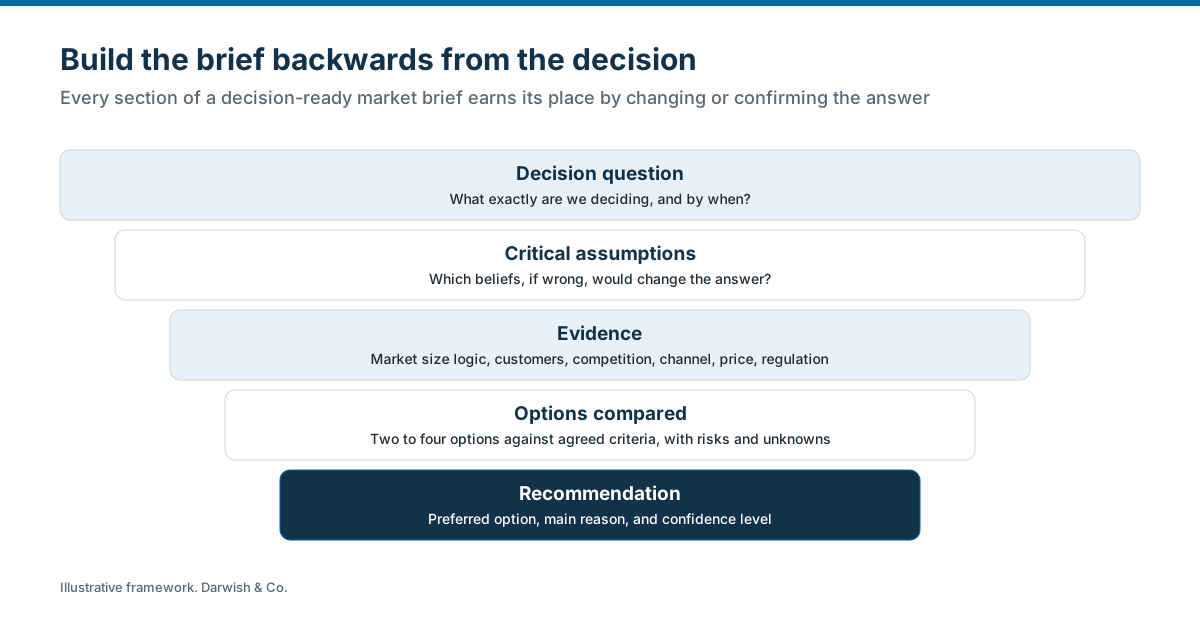
The components of a decision-ready brief
1. The decision question. One sentence at the top, agreed with the decision-makers before research begins.
2. Market definition and size logic. Define the market precisely: which products, which customers, which geography. Then show how the size estimate was built, step by step, with each assumption stated. A reader should be able to change an assumption and see how the estimate moves. A range is often more honest than a single figure.
3. Customer segments and needs. Identify the groups of customers who matter for the decision, what they need, how they buy, and what would make them switch. Segments should be defined in a way the company can act on, such as by purchase behavior or channel, not only by demographics.
4. Competitors and alternatives. Include direct competitors, but also the alternatives customers use today, including doing nothing or doing it themselves. For each, note what it implies for the company's position.
5. Channel and pricing realities. Explain how products actually reach customers in this market, who holds power in the channel, what margins intermediaries expect, and what price levels customers accept. This is where many entry plans that look attractive on paper become difficult in practice.
6. Regulatory and entry considerations. Summarize licenses, registrations, standards, ownership rules and timelines that affect entry. In Egypt, for instance, the General Authority for Investment and Free Zones is a natural starting point for investment and company setup procedures. Specialist legal advice should confirm anything material.
7. Risks and unknowns. State clearly what the research could not establish, and which risks could change the decision. Naming what is not known is a strength, not a weakness.
8. Options and recommendation. Set out two to four realistic options, including the option of not proceeding or waiting. Compare them against the criteria that matter to leadership, and make a recommendation with the reasoning behind it.
9. Confidence levels and sources. For each key finding, indicate how confident the team is and why. List the sources, so that readers can check them and so the brief can be updated later.
Desk research and field research
Not every decision needs a large field study. The right mix depends on the decision and on what is already known.
Desk research draws on existing sources: official statistics, industry reports, company filings, trade data, regulatory publications and the company's own sales data. In Egypt, the Central Agency for Public Mobilization and Statistics (CAPMAS) is the official statistics body and a common starting point. Desk research is usually enough when:
- The decision is early-stage and the goal is to decide whether to investigate further.
- Reliable, recent published data exists for the market in question.
- The decision is reversible or low-cost if the conclusion turns out to be wrong.
Field research collects new evidence directly: interviews with customers, distributors and industry participants, store visits, mystery shopping, or surveys. It is usually needed when:
- Published data is outdated, too general, or does not exist for the specific segment.
- The decision depends on how customers or channel partners will behave, which documents rarely show.
- The investment is significant or hard to reverse.
- Desk findings conflict and need to be tested.
A sensible approach is often to begin with desk research, identify the specific gaps that matter for the decision, and then commission focused field work to close only those gaps.
A one-page brief outline
The full brief may run to many pages, but its core should fit on one. The outline below can serve as the front page.
| Section | What it answers | Typical content |
|---|---|---|
| Decision question | What are we deciding? | One sentence, agreed with leadership |
| Recommendation | What should we do? | Preferred option and the main reason |
| Market and size logic | Is the opportunity large enough? | Market definition, size range, key assumptions |
| Customers | Who will buy and why? | Priority segments, needs, buying behavior |
| Competition and alternatives | Who else serves this need? | Main competitors, substitutes, implications |
| Channel and price | Can we reach customers profitably? | Route to market, channel margins, price range |
| Regulation and entry | What is required to enter? | Licenses, standards, timelines, constraints |
| Risks and unknowns | What could change the answer? | Key risks, open questions, how to resolve them |
| Options compared | What are the alternatives? | Two to four options against agreed criteria |
| Confidence and sources | How sure are we? | Confidence level per finding, main sources |
Research in service of a decision
Good market research does not end with a description of the market. It ends with a clear answer to a specific question, together with an honest account of how certain that answer is. When the brief is built around the decision from the start, the research is more focused, the meeting is shorter, and leadership leaves with a choice rather than a stack of charts.
Before commissioning a market study, it is worth agreeing the decision it must support. Darwish & Co. supports leadership teams in framing market questions, combining desk and field research, and turning evidence into clear options and recommendations.
Let’s discuss your next strategic priority.
Tell us what your organization is facing. We’ll help you frame the challenge and identify a practical next step.