
Delegation of Authority: How to Delegate Decisions Without Losing Oversight
A clear Delegation of Authority framework lets decisions move at the right level while the board and CEO keep sight of what matters. Here is how to design one and keep it working.


In many growing companies, the CEO's signature is the last step in almost every process. A purchase order, a new hire, a discount for a key customer, a change to a supplier contract: all of it waits for one person. At first this feels like control. Over time it becomes a bottleneck, and the control it appears to provide is thinner than it looks.
The opposite problem is just as common. Authority has been spread informally across the organization, nobody is quite sure who approved what, and the board learns about significant commitments after they have been made.
A Delegation of Authority framework, often called a DoA or an authority matrix, addresses both problems. It sets out who can decide what, up to which limits, with whose input, and how those decisions are reported back. Done well, it makes the organization both faster and better controlled.
What a Delegation of Authority framework is
A DoA framework is a formal document, approved by the board, that allocates decision-making authority across the organization. It typically covers three things:
- Which decisions are in scope, grouped into categories such as capital spending, operating expenditure, contracts, pricing, hiring, legal matters and banking.
- Who holds authority for each decision, by role rather than by name.
- The limits of that authority, both financial and non-financial.
It is not the same as an organization chart or a set of job descriptions. Those describe responsibilities. A DoA describes the right to commit the organization.
It also sits within the board's wider role. The G20/OECD Principles of Corporate Governance describe board functions that include reviewing and guiding corporate strategy, major plans and budgets, overseeing major capital expenditures, acquisitions and divestitures, and reviewing risk management policies. A DoA is the practical tool that shows which of these decisions the board keeps for itself and which it entrusts to management.
Signs your framework is missing or broken
Most organizations have some form of approval rules. The question is whether they work. The following signs suggest they do not:
- Everything escalates to the CEO. Senior managers bring routine decisions upward because they lack clear authority, or because they have learned that decisions made without the CEO tend to be reopened.
- Approvals happen by habit. People sign because "this is how it has always been done", not because a document says so. Ask three managers who can approve a given contract and you get three answers.
- Financial limits ignore risk. A manager may need approval to buy office furniture worth a modest amount but can sign a multi-year exclusive distribution agreement with no value stated on its face. The financial threshold catches the small, visible decision and misses the large, risky one.
- Delegation stops at one person. Authority has been given to a single manager with no rules about passing it on, so work stops when that person travels or leaves.
- The board is surprised. Significant commitments, related-party transactions or legal settlements reach the board only after the fact.
How to design a DoA framework
A practical framework does not need to be long. It needs to be clear, consistent and owned. The following elements matter most.
- Decision categories. Group decisions in a way that matches how the business actually operates. Typical categories include capital expenditure, operating budgets and overruns, revenue contracts and pricing, procurement and supplier contracts, people decisions, treasury and banking, legal and regulatory matters, and write-offs.
- Financial and non-financial thresholds. Value limits are necessary but not sufficient. Add non-financial triggers that raise a decision to a higher level regardless of value: contract duration, exclusivity, unusual payment terms, entry into a new country, dealings with government bodies, or reputational sensitivity.
- Clear roles for each decision. For each decision, show who approves, who recommends, who must be consulted and who must be informed. This removes the common confusion between being involved in a decision and owning it. The finance function, for example, is often consulted on a large contract without being the approver.
- Sub-delegation rules. State whether each authority may be passed down, to whom, in writing or not, and for how long. Temporary delegation during absence should be time-bound and recorded.
- Conflicts of interest. No one should approve a decision in which they, their family or a related business has an interest. The framework should require disclosure and route the decision to the next level or to an independent approver.
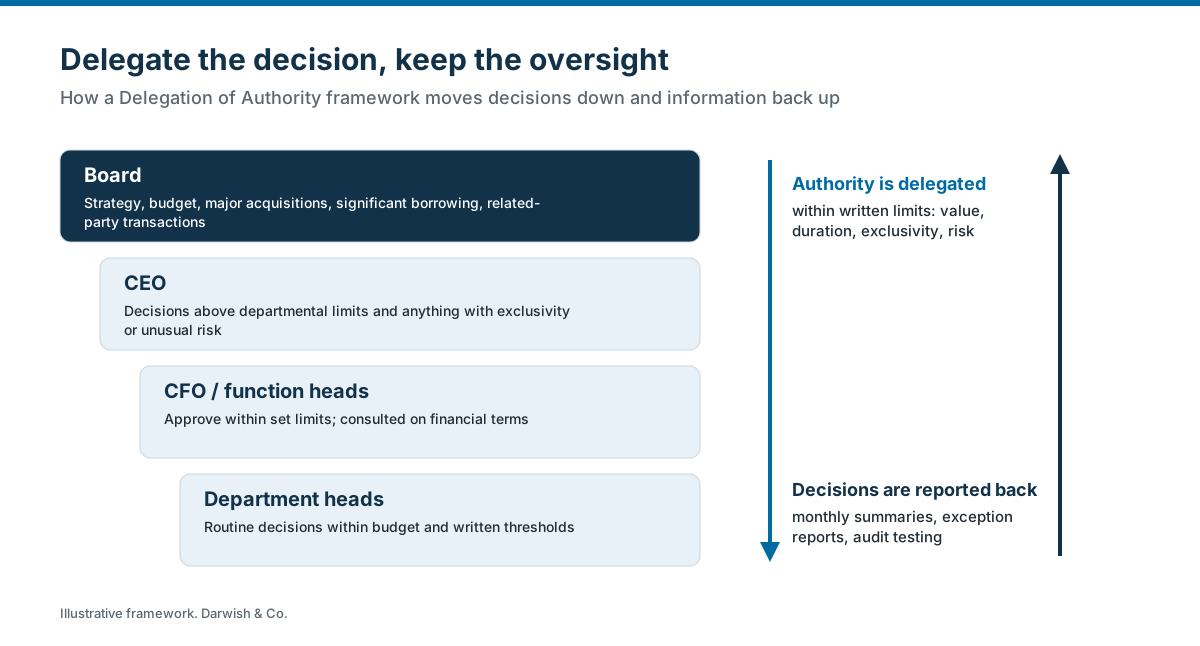
- Board-reserved matters. List the decisions that only the board can take. These usually include approval of strategy and the annual budget, major acquisitions and disposals, significant borrowing, related-party transactions above a defined level, and appointment of senior executives.
- No splitting. State plainly that a transaction cannot be divided into smaller parts to stay below a threshold. This is one of the most common ways limits are bypassed.
An illustrative DoA matrix
The table below is illustrative only. It shows the shape of a matrix, not recommended limits. Each organization should set its own thresholds based on its size, risk appetite and structure.
| Decision | Board | CEO | CFO | Department head | Notes |
|---|---|---|---|---|---|
| Capital expenditure within approved budget | Above Z | Up to Z | Recommends | Up to X | Unbudgeted items go one level higher |
| Operating expenditure outside budget | Above Y | Up to Y | Consulted | Not permitted | Report monthly to CEO |
| Revenue contracts | Above Z or over N years | Up to Z | Consulted on terms | Up to X | Exclusivity always to CEO |
| Supplier contracts | Above Z | Up to Y | Up to X | Recommends | Related parties always to board |
| Hiring within approved headcount | Senior executives | Direct reports | Consulted | Within own team | HR consulted on all offers |
| Litigation and settlements | Above Y | Up to Y | Consulted | Not permitted | Legal counsel consulted |
| Opening bank accounts | Approves | Recommends | Recommends | Not permitted | Two signatories required |
Read across a row, and the question "who can approve this?" has one answer. That is the test of a usable matrix.
Keeping oversight without micromanaging
Delegating a decision does not mean losing sight of it. The framework moves decisions closer to the work while keeping the right information flowing upward. Four mechanisms make this possible.
Reporting back. Define what delegated decisions must be reported, to whom and how often. A monthly summary of contracts signed above a certain level gives the CEO visibility without requiring the CEO to sign each one.
Exception reports. Ask for reports on what falls outside the norm: approvals granted under temporary delegation, decisions made close to a threshold, repeated transactions with the same supplier, and any cases where the framework was not followed. Exceptions tell leadership far more than routine volumes.
Periodic review. Thresholds that made sense three years ago may be too low or too high today. Review the framework at least once a year, and whenever the organization changes structure, enters a new market or appoints new senior leaders.
Internal audit testing. Internal audit, or an external reviewer where there is no internal function, should test whether the framework is followed in practice. A sample of approved transactions can show whether the right person signed, whether thresholds were respected, and whether conflicts were declared.
A short implementation sequence
For most mid-sized companies and family businesses, a DoA framework can be put in place in a few clear steps:
- Map current practice. Interview senior managers and review a sample of recent approvals to see how decisions are actually made today.
- Draft the matrix. Agree decision categories, roles and draft thresholds with the CEO and CFO.
- Test it against real cases. Run recent decisions through the draft and check whether it gives a clear and sensible answer each time.
- Approve at board level. The board should approve the framework and its board-reserved matters, and record that approval.
- Align systems. Update ERP approval workflows, bank mandates and signatory lists so that the systems enforce what the document says.
- Communicate and train. Make sure every manager with delegated authority understands their limits and the reporting that comes with them.
- Monitor and review. Put the reporting, exception and audit mechanisms in place, and schedule the first annual review.
A DoA framework is a governance document, but its real value is cultural. It tells managers that they are trusted to decide, and it tells the board that trust is backed by structure.
If decisions in your organization are slow, unclear or concentrated in too few hands, Darwish & Co. can help you map current practice, design a Delegation of Authority framework that fits your structure and risk profile, and put the reporting and review mechanisms in place to keep it working.
Let’s discuss your next strategic priority.
Tell us what your organization is facing. We’ll help you frame the challenge and identify a practical next step.