
Role Clarity Before Restructuring
Many reorganizations change boxes and reporting lines but leave unclear accountabilities untouched. Clarifying roles and decision rights first often solves the real problem, or shows what structure is actually needed.

When performance stalls, the organization chart is often the first thing leadership reaches for. Departments are merged or split, a new layer of management is added, a function is moved from one division to another. The new chart is announced, people adjust to new reporting lines, and for a few months there is a sense that something has been done.
Then the old problems return. Decisions still wait. Two managers still believe the same task is theirs, or that it belongs to someone else. Important work still falls between departments. The structure has changed, but the way work and decisions are owned has not.
This is not an argument against restructuring. It is an argument about sequence. In many organizations, the real problem is not the shape of the chart. It is that nobody is quite sure who is responsible for what.
Why reorganizations often miss the real problem
A reporting line answers one question: who is my manager? It says much less about who owns a decision, who must be consulted before it is made, and who does the work once it is made. Those questions sit underneath the chart, and they are where most friction comes from.
Three patterns appear again and again:
- Unclear accountabilities. A result matters to the business, but no single person is answerable for it. Everyone contributes, so no one owns it.
- Overlapping roles. Two or more positions carry similar duties, often because roles were added over time without revisiting the ones already there. People either duplicate effort or wait for each other.
- Decisions with no owner. Some decisions are made by whoever happens to be in the room, or escalate to the chief executive by default because no one below feels authorized to make them.
Moving boxes on a chart does not resolve any of these. A merged department can inherit the same overlaps on a larger scale. A new management layer can add one more place for decisions to wait.
Diagnosing role clarity
Before any change to structure, it helps to find out how roles and decisions actually work today. This does not require a large study. Four sources usually give a clear picture.
Interviews. Short, structured conversations with managers and staff across levels. Useful questions include: Which decisions do you make on your own? Which do you need approval for, and from whom? Where do you regularly wait for someone else? What work do you think nobody owns?
A review of existing responsibility charts. If the organization already has a responsibility matrix or delegation of authority, compare it with what people describe in interviews. The gap between the document and practice is often the most useful finding.
A decision inventory. List the recurring decisions that matter most: pricing exceptions, hiring, capital spending, supplier selection, customer complaints above a certain level, and so on. For each one, record who currently makes it, who believes they make it, and how long it typically takes.
Job description gaps. Read the job descriptions for key roles side by side. Look for duties that appear in two places, important responsibilities that appear nowhere, and descriptions that no longer match what the person actually does.
RACI: useful, but not the whole answer
A common tool for this work is the responsibility assignment matrix, usually called RACI. It lists tasks or decisions down one side and roles across the top, and assigns each role one of four letters. In common usage, Responsible means the people who do the work; Accountable means the one person ultimately answerable for the outcome and who signs it off; Consulted means those whose input is sought before the work is done; and Informed means those who are kept up to date.
The illustrative example below shows how a RACI might look for a few decisions in a mid-sized distribution company. It is a hypothetical example, not a recommended allocation.
| Decision or task (illustrative) | CEO | Commercial Director | Finance Manager | Sales Manager | HR Manager |
|---|---|---|---|---|---|
| Approve discount above standard limit | I | A | C | R | - |
| Hire a new sales representative | - | A | I | R | C |
| Approve annual sales budget | A | R | C | C | - |
| Change customer credit terms | I | C | A | R | - |
RACI is valuable because it forces a specific conversation. Writing a single "A" against each decision quickly reveals where two people think they are accountable, or where nobody is.
It also has limits worth keeping in mind:
- It describes who does what, not how well. A clear chart does not make a weak decision-maker effective.
- It can grow too large to use. A matrix with hundreds of rows is rarely read after it is approved.
- Too many "C" entries slow decisions down. Consultation is useful, but every consulted role is another place where work can wait.
- It is static. If it is not reviewed when roles or priorities change, it drifts out of date.
Used for the decisions that matter most, and kept short, it is a practical starting point rather than a final answer.
Clarify roles and decisions first, then structure
The sequence matters because role clarity work often changes the question. Consider a company where leadership believes the operations and commercial teams need to be merged because coordination is poor. A decision inventory might show that the real issue is that nobody owns the decision to accept a non-standard customer order. Assigning that decision clearly, with a defined route for consultation, may resolve most of the friction without any structural change.
In other cases, the clarity work shows that the structure genuinely is the obstacle. Either way, the organization now changes structure on the basis of evidence, and the new chart is designed around decisions and accountabilities that have already been agreed.
Signs that restructuring is actually needed
Clarifying roles will not fix everything. Structural change is more likely to be justified when:
- Responsibilities have been clarified, but a single manager is still accountable for more than one person can reasonably oversee.
- The business has changed direction, for example entering a new market or adding a new line of business, and no existing unit is set up to own it.
- Two units serve the same customers or run the same processes in parallel, and the duplication cannot be resolved by reallocating tasks.
- Reporting lines create a clear conflict of interest, such as a control function reporting to the area it is meant to check.
- Accountabilities are clear on paper, but decisions still cannot be made without crossing several units, because related work has been split in the wrong place.
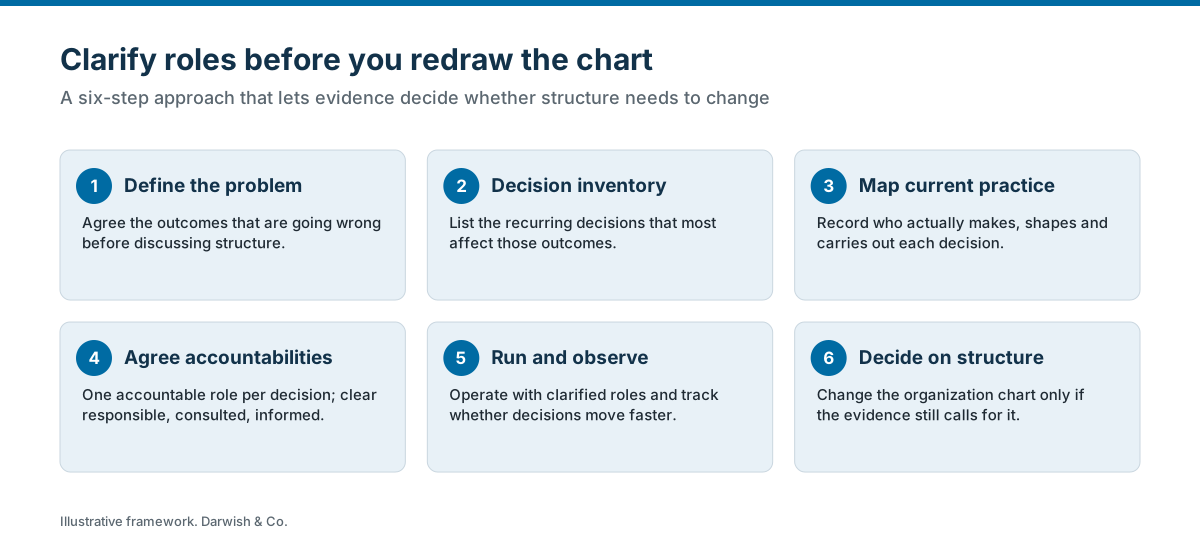
A practical six-step approach
- Define the problem in terms of outcomes. Before discussing structure, agree what is going wrong: slow decisions, missed targets, duplicated work, customer complaints. Be specific.
- Build a decision inventory. Identify the recurring decisions that most affect those outcomes. Keep the list focused on what matters.
- Map current practice. Through interviews and document review, record who actually makes, influences and carries out each decision today, and where the gaps and overlaps are.
- Agree accountabilities. For each decision, agree a single accountable role, the roles responsible for doing the work, and the minimum necessary consultation. Update job descriptions and the delegation of authority to match.
- Run it and observe. Operate with the clarified roles for a defined period. Track whether decisions move faster and whether disputes about ownership fall away.
- Decide on structure with evidence. Only then ask whether the organization chart still needs to change. If it does, design the new structure around the accountabilities already agreed.
Structure follows clarity
An organization chart is a picture of reporting relationships, not a description of how the organization works. When leaders first make responsibilities and decision rights clear, they either avoid an unnecessary reorganization or make a necessary one far more likely to succeed.
Before redrawing the organization chart, it is worth confirming that the problem is really structural. Darwish & Co. supports leadership teams in reviewing role clarity, decision rights, job design and organizational structure, and in sequencing change so that it addresses the real cause.
Let’s discuss your next strategic priority.
Tell us what your organization is facing. We’ll help you frame the challenge and identify a practical next step.