
How to Turn Strategy into Decision Rights, Measures and Monthly Reviews
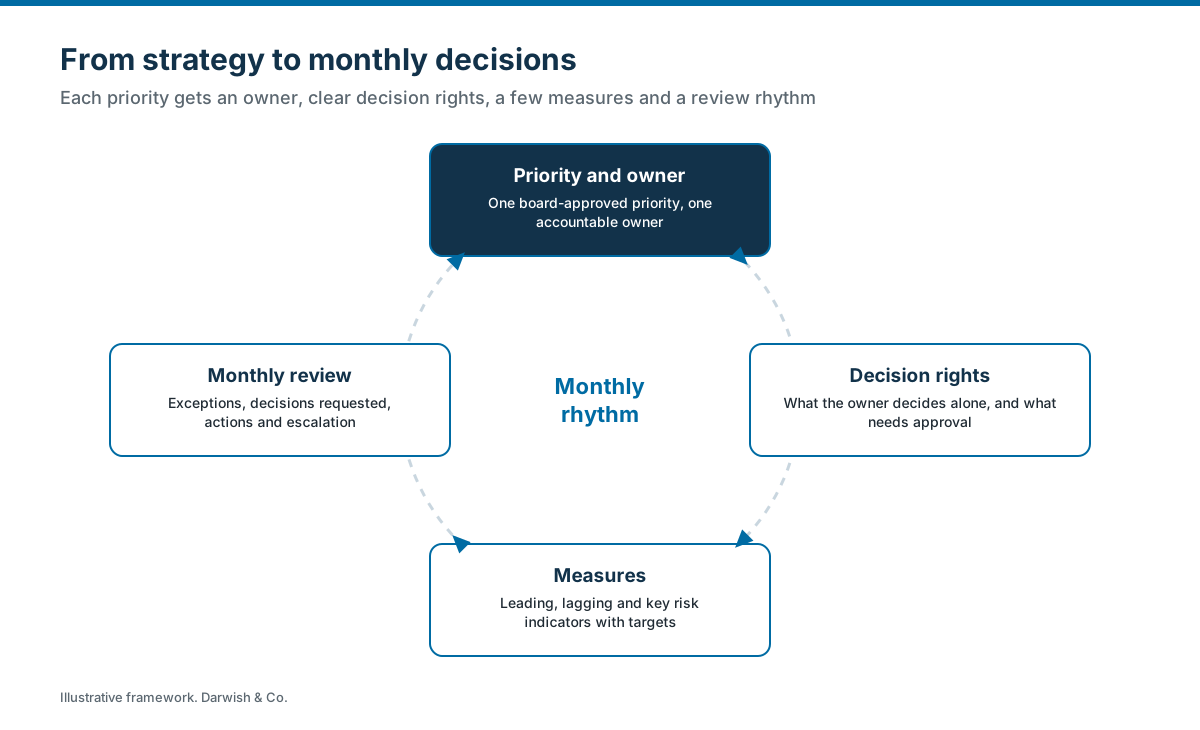
Most strategies stall between the board presentation and daily work. Clear owners, decision rights, a few good measures and a steady monthly review close that gap.

Most leadership teams can produce a credible strategy. They hold an offsite, agree priorities, and the board approves a well-argued presentation. Six months later, little has changed. Managers are busy, the budget has been spent, and yet the priorities in the presentation look much as they did on the day they were approved.
This is rarely a failure of analysis. It is a failure of translation. The strategy was never turned into decisions that specific people are entitled and expected to make, measures that show whether those decisions are working, and a routine in which leadership looks at both and acts.
This article sets out a practical way to make that translation.
Why strategies stall
Strategies tend to stall in the space between the board deck and the daily work. A few causes appear again and again:
- Priorities without owners. A priority such as "grow the export business" belongs to everyone, which in practice means it belongs to no one.
- Unclear decision rights. The person asked to deliver a priority cannot make the decisions it requires, such as hiring, pricing or choosing a partner, without going back to the CEO each time.
- Too many measures. Monthly reports contain dozens of indicators, most of which describe activity rather than progress.
- Reviews that only report. Management meetings walk through numbers but rarely end in decisions, so problems are noted and carried forward.
- Competing calendars. Strategy work is treated as extra to the "real" job, and loses every time it competes with operational pressure.
None of these require a new strategy to fix. They require a system that connects the strategy to how the organization runs.
From priorities to owners and decision rights
Start by breaking each strategic priority into a small number of objectives that a single person can own. "Grow the export business" might become "secure two new distributors in target markets" and "adapt the product range for export certification." Each objective needs one named owner. Others will contribute, but one person is accountable.
Then define what that owner can decide. For each objective, ask:
- Which decisions does this objective require? Budget allocation, hiring, pricing, supplier choice, partnership terms.
- Who decides each one, and at what level? Some decisions can sit with the owner. Others need CEO or board approval.
- Who must be consulted, and who must be informed? This prevents both bottlenecks and surprises.
- What are the limits? State the financial and non-financial boundaries within which the owner can act without further approval.
This is where strategy meets governance. If the organization already has a Delegation of Authority framework, the decision rights for strategic objectives should be consistent with it. If it does not, this exercise is a good reason to build one.
The board's role in this is well recognised. The G20/OECD Principles of Corporate Governance include among the board's key functions reviewing and guiding corporate strategy, major plans of action, annual budgets and business plans, and setting performance objectives. Clear decision rights let the board do that without being drawn into daily management.
Choosing a small set of measures
Each objective needs a small number of measures that show whether it is on track. Two or three per objective is usually enough. More than that, and attention spreads too thin.
Good measures combine different types:
- Lagging measures show results after the fact: revenue from export markets, margin, customer retention. They confirm whether the strategy is working but arrive too late to change course quickly.
- Leading measures show whether the actions that drive results are happening: number of qualified distributor meetings held, certification milestones completed, proposals submitted. They give earlier warning.
- Key performance indicators (KPIs) track progress toward the objective.
- Key risk indicators (KRIs) signal that a risk to the objective is rising: dependence on a single distributor, delays in regulatory approval, currency exposure, staff turnover in a critical team.
Every measure needs a definition, a data source, a target, a reporting frequency and an owner. If a measure cannot be produced reliably each month, either fix the data or choose a different measure. A measure that is reported late or argued over every month will undermine the review it is meant to support.
A monthly review leadership can sustain
The monthly review is where the system either works or fails. It should be short, regular and focused on decisions. A sustainable rhythm usually looks like this:
Pre-reads. Each objective owner submits a one-page update a few working days before the meeting: status, measures against target, risks, and any decisions requested. Leadership reads these in advance, so meeting time is not spent presenting.
A fixed agenda.
- Actions from the previous meeting: done, late or dropped.
- Objectives that are off track or at risk, by exception. Objectives on track are not discussed unless someone asks.
- Decisions requested by owners.
- Emerging risks and changes in the environment.
- Agreed actions, owners and dates.
A decisions log. Record every decision made, who made it, and the reasoning. Over time, this becomes a valuable record of how the strategy has evolved and why.
Clear escalation. Define what goes to the board and when. An objective that remains off track for a set period, or a risk indicator that crosses an agreed level, should trigger escalation rather than another month of discussion.
Quarterly, the review should step back further: are these still the right objectives, measures and targets? A strategy that never changes in response to evidence is not being managed.
Common failure modes
Even well-designed systems drift. Watch for these signs:
- The review becomes a reporting meeting. If meetings end without decisions, the agenda or the pre-reads need attention.
- Measures multiply. Each new concern adds an indicator, and none are removed. Prune at every quarterly review.
- Owners lack authority. If owners keep bringing small decisions to the meeting, their decision rights are too narrow.
- Targets are negotiated down. Targets should be realistic, but if they are lowered every time they are missed, they stop meaning anything.
- The CEO skips the meeting. When the most senior person stops attending, everyone else learns that the review does not matter.
A one-page template
The following one-page format can be used for each objective in the monthly pack. It is a template, not a model of any specific organization.
| Field | What to include |
|---|---|
| Strategic priority | The board-approved priority this objective supports |
| Objective | One specific outcome, stated plainly |
| Owner | One named person accountable for delivery |
| Decision rights | What the owner can decide alone, and what needs approval |
| Leading measures | One or two indicators of progress on key actions, with targets |
| Lagging measures | One or two indicators of results, with targets |
| Key risk indicators | One or two signals that a risk is rising, with trigger levels |
| Status | On track, at risk or off track, with a one-line reason |
| Decisions requested | What the owner needs from leadership this month |
| Actions and dates | Agreed next steps, owners and deadlines |
Kept to a single page, this format forces clarity. If an owner cannot fill it in, the objective is probably not yet clear enough to manage.
A strategy becomes real when people know what they are allowed to decide, how success will be judged, and when leadership will next look at the evidence. Building that system takes discipline more than sophistication, and it pays back each month it runs.
Darwish & Co.'s Strategy & Performance practice helps leadership teams turn approved strategies into clear objectives, decision rights, measures and review routines, and supports the first cycles of monthly review until the rhythm holds on its own.
Let’s discuss your next strategic priority.
Tell us what your organization is facing. We’ll help you frame the challenge and identify a practical next step.